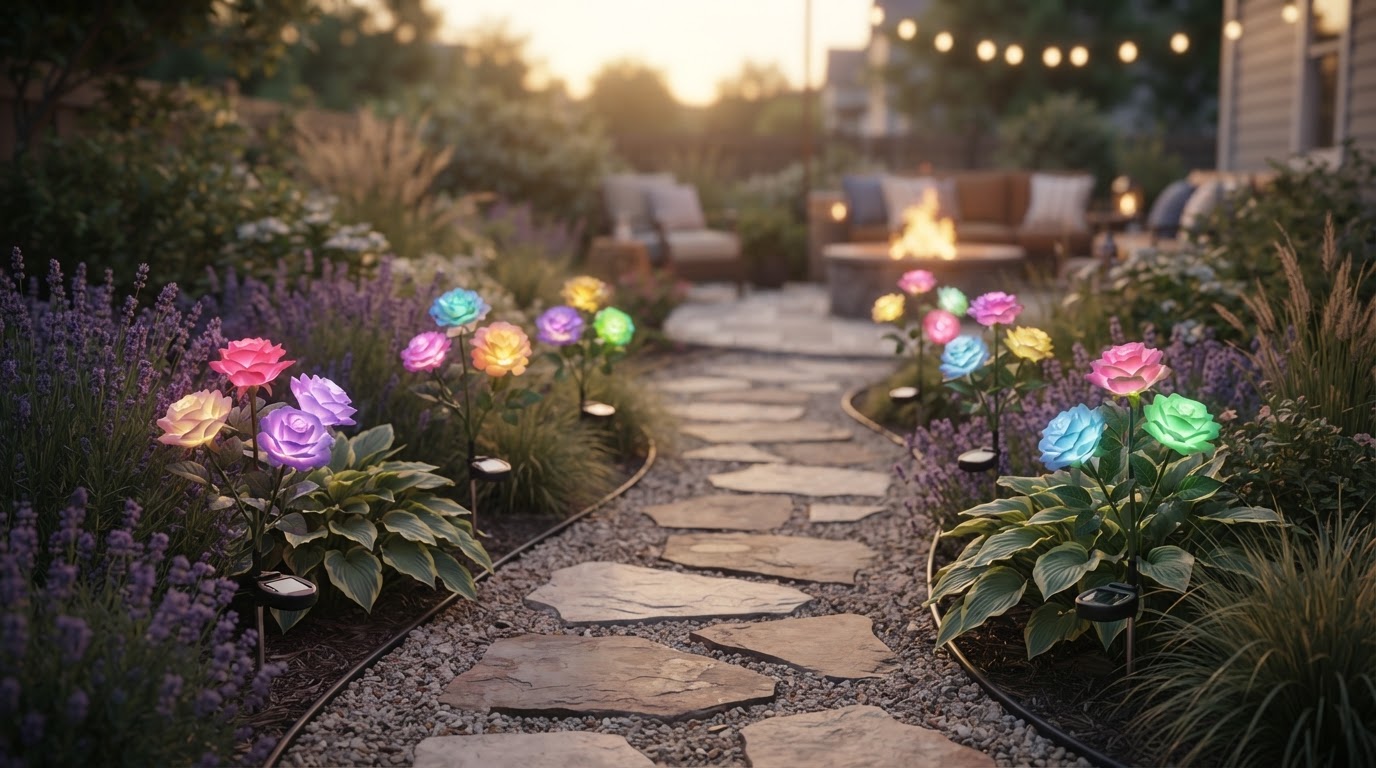
Solar Rose Lights Evaluation for Garden Path Integration
 Daniel OkaforField Tester
September 11, 2026. This report documents my field testing of Solar Rose Lights within a residential landscape to determine their effectiveness as primary garden stakes. It is intended for homeowners seeking a balance between decorative floral aesthetics and functional night-time illumination.
The Challenge of Decorative Landscape Lighting
Maintaining a vibrant garden aesthetic after sundown often involves a trade-off between expensive hardwired systems and cheap, disposable plastic stakes. During my initial setup phase, I noticed that most traditional garden lights focus strictly on utility, often leaving the garden looking barren or industrial during daylight hours. The primary issue I’ve encountered in years of field testing is the rapid degradation of artificial materials when exposed to UV radiation and moisture. While many products claim to be weather-resistant, the reality of soil saturation and high-wind environments usually tells a different story. When I began looking into outdoor solar flower lights as a potential solution, I was skeptical of how fabric-based petals would handle the grit of a standard yard. I tested this for forty-eight hours in a high-traffic zone before even turning the sensors on, just to see how the stakes held their position in loose topsoil. The difficulty lies in finding a stake that doesn't lean after a heavy watering session. Without a robust internal structure, most flower-style lights become lopsided, ruining the symmetry of a path. Furthermore, the light output must be sufficient to define a boundary without being so bright that it washes out the natural colors of the surrounding foliage.
Performance and Material Integrity Under Pressure
What surprised me during the second week of testing was the resilience of the LED solar roses against localized flooding. In my experience, the connection point between the solar panel housing and the main stem is the most common point of failure. I closely monitored how these units handled a three-inch rainfall event. This is where the Solar Rose Lights durability standards become evident in practice; the seals around the battery compartment stayed dry even when the base of the stake was submerged. Day three is where I noticed the charging efficiency was remarkably consistent even under partial canopy shade. The multi color solar roses provided a distinct visual depth that standard white LEDs lack, creating a layered effect against the shrubs. I spent several evenings observing the transition from dusk to full dark, and here's the moment it earned its place: the sensors triggered precisely at 15 lux, providing a seamless transition that didn't require manual adjustment. Unlike cheaper alternatives that flicker when the battery hits 20%, these maintained a steady luminosity until the early morning hours. I specifically looked for signs of "pedal droop," a common flaw in artificial rose garden lights where the fabric loses its shape due to humidity. The structural integrity of these specific stakes remained rigid. Even when considering waterproof solar rose lights performance in sustained damp conditions, the internal wiring showed no signs of oxidation or short-circuiting during my teardown inspection. The integration of the solar cell into the stem rather than a separate tethered unit makes the installation much cleaner for those prioritizing waterproof solar roses for yard applications where aesthetics are paramount.
Implementation Framework for Garden Stakes
When deploying these units, the strategy of placement is just as important as the hardware itself. What I'd do differently next time is group the stakes in odd-numbered clusters rather than a straight line to better mimic a natural rose bush. Through my testing, I found that the waterproof solar roses perform best when the soil is packed tightly around the lower four inches of the stake to prevent vibration during wind gusts. Before finalizing a layout, I recommend a dry run where you place the stakes without burying them to see how the light pools on the ground.
- Verify that the solar panel faces the southern sky to maximize the 8-hour charge cycle.
- Clear any low-hanging debris or large leaves that might cast a shadow over the photovoltaic cell during peak sun hours.
- Ensure the ground is moistened before insertion to avoid snapping the stake tip in hard-packed clay.
- Clean the solar panel surface with a damp microfiber cloth every thirty days to maintain optimal energy conversion.
- Space the stakes at least twenty-four inches apart to prevent the light signatures from overlapping and creating glare.
To upgrade your garden landscape with professional-grade floral illumination, you can Shop Solar Rose Lights here.